For CFOs, controllers & accounting teams

Put AI to work in your finance department. Fast, and auditable.

Start with workflows that speed up the month-end. Then add AI agents that chase receivables, answer the phones, work the AP inbox, run your morning briefing and onboard new hires, with the controls your auditors expect.

Where to start

Three steps, at your own pace

Step 1 · Free

Learn the workflows

16 step-by-step workflows for the close, reporting, forecasting, board decks and more. Each comes with the prompt, the setup and a reviewer checklist.

Step 2 · $79

Speed up the close

The Month-End Close Toolkit: checklist, reconciliations, flux and journal entries on one status page, plus nine AI prompts for the close.

Step 3 · $99

Deploy AI agents

Five agent playbooks with prompts and workbooks: AR collections, AI receptionist, AP invoices, executive assistant and HR onboarding. Tools, setup, compliance and controls.

AI agents for finance

The work that eats your team's week, done by agents

  • AR collections agent. Emails first, then calls past-due customers on Thursday, says it's an AI, offers "press zero for a person," and reports back who promised what.
  • AI receptionist. Answers the main line, routes calls and takes messages, and never confirms bank details to a caller.
  • AP invoice agent. Reads the AP inbox, codes and matches invoices, and flags duplicates and bank-change attempts.
  • Executive assistant. Sorts your inbox, drafts replies and briefs you at 7 a.m. Never sends on its own.
  • HR onboarding agent. Runs the new-hire checklist, chases paperwork and answers handbook questions.

The rule behind all five: agents do the repetitive work around the money. People approve, pay, and handle anything unusual.

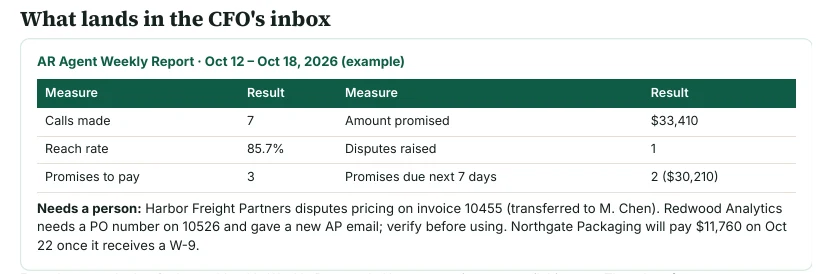
Example weekly report from the AR collections agent: calls made, reach rate, amount promised and accounts that need a person
What lands in the CFO's inbox every Thursday afternoon.

Fast, and auditable

Everything ships with the check

01

The instructions

Prompts and agent scripts written to stop the AI from guessing, to say what it can't support, and to hand off to a person.

02

The controls

What never to paste, which steps stay with people, and the compliance and fraud checks a finance team needs.

03

The review

A reviewer checklist or a weekly report, so you can see what the AI did and defend it to an auditor or a board.

From the free library

Popular workflows

See all 16 workflows →

Reporting & MD&A

Draft MD&A variance commentary from budget vs. actual

Turn a budget-vs-actual schedule into a clear management discussion that explains revenue, margin and expense variances, and flags every variance it cannot explain instead of guessing.

BeginnerAbout 15 minutes

Reporting & MD&A

Turn a trial balance into a month-end reporting package

Use AI to map your chart of accounts to financial statement lines, then drop the trial balance into a formula-driven template that builds the balance sheet, income statement, cash flow and budget comparison, with automatic tie-out checks.

Beginner45 min first month, then 10

Month-End Close

Explain income statement flux month over month

Rank income statement movements by size, and get a list of likely causes to check in the general ledger for each one, so your flux review starts with the right questions.

BeginnerAbout 20 minutes

Free download

The month-end reporting package, already built

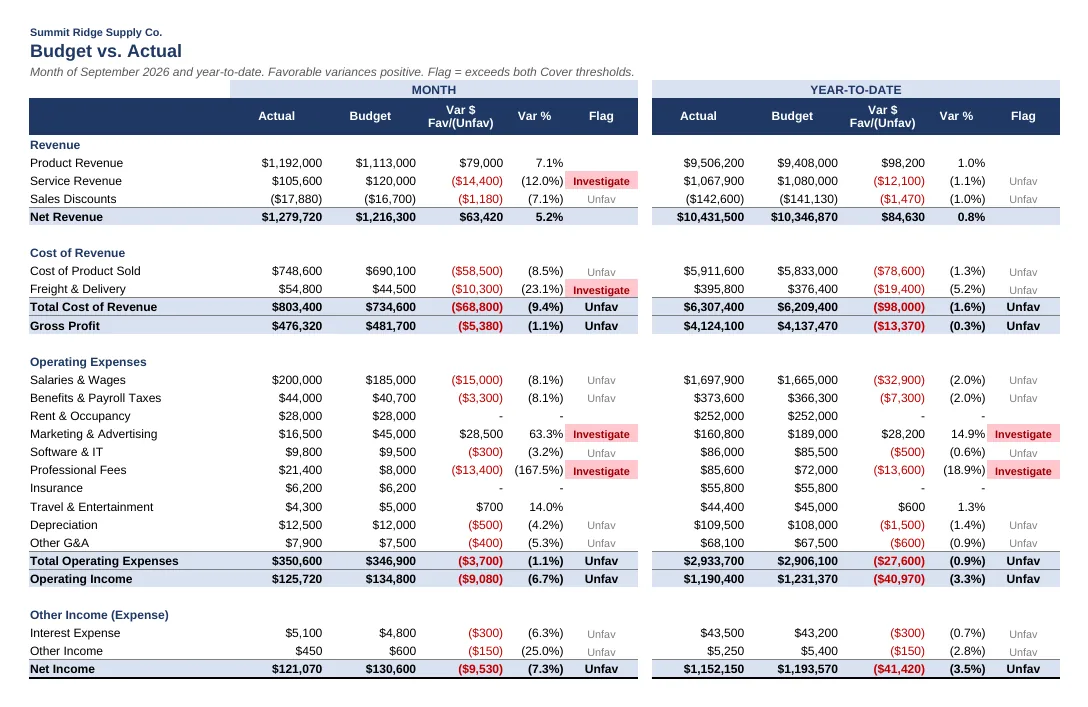
Paste in a trial balance and get a clean balance sheet, income statement, cash flow, budget vs. actual, full-year outlook and an MD&A page, every number driven by formulas.

  • 13 automatic tie-out checks, so math errors can't slip through
  • Variance flags set to your own materiality thresholds
  • Change one date and the whole package rolls forward
Budget vs. actual tab of the CFO Resource month-end workbook, with variance flags

Why this exists

Built by a CFO who did it the slow way

I'm Dan Allen. I founded ITS Logistics in 1999 and ran its finances as CFO, then the company as CEO, after about a decade in audit at Grant Thornton. Along the way I built pricing models, forecasts and board decks by hand, then reformatted them until they looked right. Month-end support lived in spreadsheets that too often had math errors, and SOPs took forever to write and were hard to find once they existed.

I was bombarded with the next thing to read and the next new software. What I wanted was quick, practical tools that improved the quality of the work, cut the time it took, and let my team get more done without another hire. That's what CFO Resource is: the playbook I wish I'd had.

More about me →

Not ready to buy? Start with the newsletter.

One workflow a week, free. You get the month-end workbook right away.